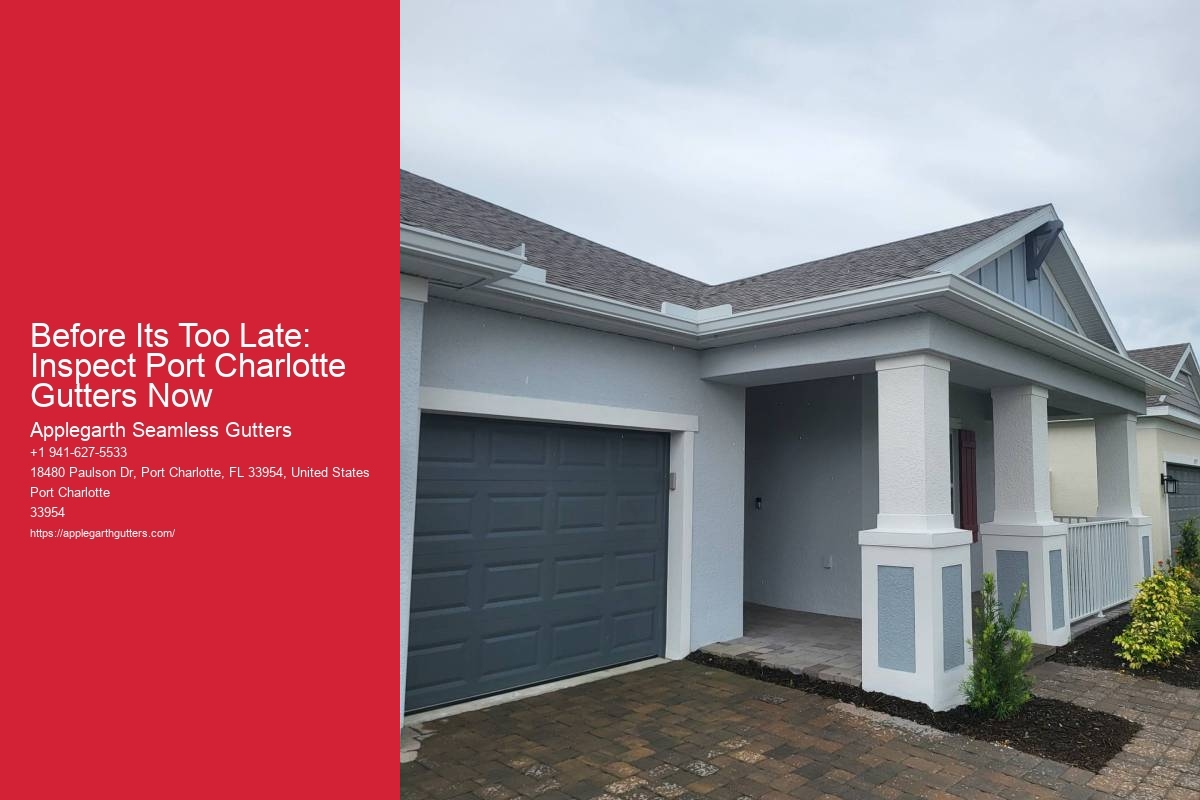
Before Its Too Late: Inspect Port Charlotte Gutters Now
Roof
Oh, Port Charlotte residents, you probably think about sunny afternoons and fishing trips, not about the channels on the edge of your roof (and yeah, they matter more than you think). Tessellated roofSoffit and Gutter Installation Gutters is often ignored until something goes wrong - and then its a scramble. Gutter System Installation I mean, who wants to climb a ladder on the weekend? Seamless Gutters Still, not checking them wont make problems vanish.
There is many reasons to take a peek: heavy rains, salt air, palm fronds, and mud can clog those troughs, cause sagging, and even invite pests.
Storm drain
Fascia Gutter Installation
Gutter Flushing
Gutter Replacement
Rain Gutter Installation
Gutter Installation
Barrel roof
Eaves
Gutter Cleaning
If water cant flow away itll find another route - into siding, into foundations, or under shingles - which is expensive to fix.
Gutter System Installation
Gutter Maintenance
Gutter Debris Removal
Gutter Inspection
Gutter Repair
Street gutter
Emergency Gutter Services
Leaf Guard
Gutter Rust Repair
You dont have to be handy to spot the obvious signs either: overflow, rust stains, or downspouts that dont direct water away from the house (especially after storm season).
Do a quick inspection every few months - or after a big storm - and you should of cleared out the debris if you can.
Storm drain
Roof garden
Vinyl Gutters
Rainwater harvesting
Tented roof
Rainwater Management
Rainwater tank
Rain gutter
Gutter Painting
Clogged Gutter Cleaning
Residential Gutter Services
Gutter Maintenance
Gutter Debris Removal
Gutter Inspection
Gutter Repair
Gutter Guard InstallationGutter Sealing If the troughs are dented or pulling away, call someone; dont try to fix major problems alone unless you really know what youre doing. Professionals can check slope, fasteners, and the small stuff that most of us miss. Gutter Resurfacing Theyll tell you whether seals are leaking or if new guards would help.
Ignoring maintenance can lead to rotted fascia, mold, or worse, interior damage. Theres a lot at stake for what seems like a tiny piece of your home. Read more about Port Charlotte gutter repair specialists here. So take five minutes this weekend to look up, poke around, and make a plan - dont assume time will fix it for you. Act now!
RoofStorm drain
Seamless Gutters
Gutter Debris Removal
Gutter Inspection
Gutter Repair
Street gutter
Emergency Gutter Services
Leaf Guard
Gutter Rust Repair
Fascia Gutter Installation
Gutter Flushing
Gutter Replacement
Rain Gutter Installation
Gutter Installation
Barrel roof
Eaves
Gutter Cleaning
Downspout repair Port Charlotte
Leaf guard installation Port Charlotte
In the 1950s, the now defunct General Development Corporation led by the Mackle brothers decided to take advantage of the Florida land boom and developed land primarily on both of Florida's coastlines. Among the areas they planned and developed was the Port Charlotte area. Ultimately, Port Charlotte became the most populous community in Charlotte County, although like most GDC developments, Port Charlotte remained an unincorporated community.
Gutters, in bowling and table shuffleboard, the trough hazards on either side of the playing lane into which the bowling ball or shuffleboard puck may fall
This disambiguation page lists articles associated with the title Gutter.
If an internal link led you here, you may wish to change the link to point directly to the intended article.
Port Charlotte is a census-designated place and unincorporated community in Charlotte County, Florida, United States. The population was 60,625 at the 2020 census, up from 54,392 at the 2010 census. It is included in the Sarasota metropolitan area.
Port Charlotte was named to the "10 Best Places to Retire", in the United States for the year 2012 by U.S. News & World Report.[5]
The Calusa originally settled around the Port Charlotte area.[6] In 1819, Florida was ceded by the Spanish and became a U.S. territory, and in 1845 Florida became the 27th state. For the first 100 years of statehood, the area around Port Charlotte was mostly undeveloped. Maps of the area at the turn of the 20th century show that most of the roads and railroads leading into southwest Florida had bypassed the Port Charlotte area.[7][8] Aside from some cattle ranches and small farming, the area was mostly uninhabited. This would change when the post-World War II boom opened people's eyes to the possibility of developing land in Florida.
In the 1950s, the now defunct General Development Corporation led by the Mackle brothers decided to take advantage of the Florida land boom and developed land primarily on both of Florida's coastlines. Among the areas they planned and developed was the Port Charlotte area. Ultimately, Port Charlotte became the most populous community in Charlotte County, although like most GDC developments, Port Charlotte remained an unincorporated community.
Port Charlotte was severely impacted by Hurricane Charley on August 13, 2004. The hurricane, predicted to hit Tampa as a Category 2 hurricane, took a last-minute right hand turn and intensified into a Category 4 storm as it made landfall near Charlotte Harbor and caused severe damage in the city of Punta Gorda and in the Port Charlotte area.[9] The storm's 145 miles per hour (233 km/h) maximum sustained winds destroyed almost half of the homes in the county and caused heavy ecological damage to sensitive wetlands in the area.[9][10]
Just over 18 years later, Port Charlotte was once again severely impacted by a major hurricane, this time Hurricane Ian on September 28, 2022. Ian made landfall as a Category 4 storm in Cayo Costa State Park before moving north-east into Charlotte Harbor, with south-eastern Port Charlotte going through the eye of the storm.[11] Ian caused severe damage to Port Charlotte, mostly wind-related, and to the rest of the surrounding area.[12] Maximum sustained winds of 115 miles per hour (185 km/h) and a wind gust of 132 miles per hour (212 km/h) were reported by a private weather station in Port Charlotte.[13]
Port Charlotte is located at the north end of the Charlotte Harbor Estuary, northwest of the city of Punta Gorda. It is 100 miles (160 km) south of Tampa and 65 miles (105 km) north of Naples. According to the United States Census Bureau, the CDP has a total area of 32.3 square miles (83.7 km2), of which 28.4 square miles (73.6 km2) is land and 3.9 square miles (10.1 km2) (12.01%), is water.[14]
Since Port Charlotte is unincorporated, it is governed by the Charlotte County Board of County Commissioners. The county is governed by a 5-person county commission. They take turns rotating into the commission chair position every year. County commissioners frequently sit on other regional boards involving other municipalities and counties.
Port Charlotte CDP, Florida – Racial and ethnic composition Note: the US Census treats Hispanic/Latino as an ethnic category. This table excludes Latinos from the racial categories and assigns them to a separate category. Hispanics/Latinos may be of any race.
As of the 2020 United States census, there were 60,625 people, 25,925 households, and 16,077 families residing in the CDP.[22]
According to Sperling's Best Places, as of July 2015 the family median income in Port Charlotte was $48,911, and household income was $40,049. The per capita income was $22,681. Port Charlotte's unemployment rate was 5.50%, compared to 6.30% for the United States overall.
As of the 2010 United States census, there were 54,392 people, 24,501 households, and 15,658 families residing in the CDP.[23]
As of the census[2] of 2000, there were 46,451 people, 20,453 households, and 13,601 families residing in the CDP. The population density was 2,085.9/sq mi (805.3/km2). There were 23,315 housing units at an average density of 1,047.0 per square mile (404.2/km2). The racial makeup of the CDP was 89.23% White, 6.53% African American, 0.28% Native American, 1.14% Asian, 0.05% Pacific Islander, 1.18% from other races, and 1.59% from two or more races. Hispanic or Latino of any race were 5.16% of the population.
In 2000, there were 20,453 households, out of which 20.8% had children under the age of 18 living with them, 53.2% were married couples living together, 10.1% had a female householder with no husband present, and 33.5% were non-families. 28.2% of all households were made up of individuals, and 18.6% had someone living alone who was 65 years of age or older. The average household size was 2.25 and the average family size was 2.71.
In 2000, in the CDP, the age distribution of the population shows 18.7% under the age of 18, 5.4% from 18 to 24, 21.0% from 25 to 44, 24.2% from 45 to 64, and 30.7% who were 65 years of age or older. The median age was 49 years. For every 100 females, there were 87.7 males. For every 100 females age 18 and over, there were 84.2 males.
The gymnasium at Family Christian Academy, formerly known as Community Christian School
Public schools in Port Charlotte are operated by Charlotte County Public Schools.[26] For the 2007-08 school year, all schools in Port Charlotte received A's from the Florida Department of Education.[27]Port Charlotte High School is the only traditional public high school located in Port Charlotte, although some parts of Port Charlotte are considered part of Charlotte High School's area, and students have the option to attend Charlotte Virtual School, a charter school, a special needs school, or a different traditional public high school through school choice.[28] There are numerous private schools in Port Charlotte,[29] including Family Christian Academy (formerly known as Community Christian School),[30] Charlotte Preparatory School (formerly known as Charlotte Academy),[31] Genesis Christian School,[32] Joyful Noise Learning Center, Port Charlotte Adventist School,[33] Port Charlotte Christian School, and St. Charles Borromeo Catholic School.[34] Port Charlotte is home to three small higher education facilities, including Charlotte Technical College,[35]Southern Technical College's Port Charlotte campus,[36] and Southwest Florida Bible Institute.[37]
The Mid-County Regional Library and the Port Charlotte Library are located in Port Charlotte. They are included in the Charlotte County Library System.
1963 – The Port Charlotte, Punta Gorda, and Englewood Public Libraries joined and formed the Charlotte County System.
1968 – The Port Charlotte Library moved to the Cultural Center of Charlotte County, the present location.
1985 – The Murdock Library was established as the library system administrative facility.
1996 – The Charlotte County Library System updated circulation with an automated catalog system.
2005 – Murdock Public Library moved to the new Mid-County Regional Library facility.
2022 – The Mid-County Regional Library and Port Charlotte Public Library were both damaged and temporarily closed as a result of Hurricane Ian. However, the latter reopened in November of the same year while Mid-County Regional Library remains under repair. Each location had hours extended on certain days to accommodate the continued closure of Mid-County Regional Library. Customers were able to pick-up holds from Centennial Park Recreation Center north of Port Charlotte.[39]
^Houck, Douglas; et al. (Charlotte County Historical Center Society) (2011). Historic Charlotte County: An Illustrated History. San Antonio, Texas: Historical Publishing Network. ISBN9781935377337. OCLC711782527.
^"Walter Minx". Roberson Funeral Home & Crematory. Retrieved February 4, 2025.
^Martin, Douglas. "Dr. Thomas C. Peebles, Who Identified Measles Virus, Dies at 89", The New York Times, August 4, 2010. Accessed July 18, 2024. "Dr. Thomas C. Peebles, whose D in college biology belied a keen aptitude for medical research that led him to make landmark scientific advances including identifying the virus that causes measles, died on July 8 at his home in Port Charlotte, Fla."
Lead guttering: slate and pitched valley gutter flow into parapet gutter, with downpipe and overflowEaves gutter and downpipeDecorative lead hopper head dated 1662, Durham Castle
A rain gutter, eavestrough, eaves-shoot or surface water collection channel is a component of a water discharge system for a building.[1] It is necessary to prevent water dripping or flowing off roofs in an uncontrolled manner for several reasons: to prevent it damaging the walls, drenching persons standing below or entering the building, and to direct the water to a suitable disposal site where it will not damage the foundations of the building. In the case of a flat roof, removal of water is essential to prevent water ingress and to prevent a build-up of excessive weight.
Water from a pitched roof flows down into a valley gutter, a parapet gutter or an eaves gutter. An eaves gutter is also known as an eavestrough (especially in Canada), spouting (in New Zealand), rhone or rone (Scotland),[2][3][4][5][6]eaves-shoot (Ireland), eaves channel,dripster, guttering, rainspouting or simply as a gutter.[7] The word gutter derives from Latin gutta (noun), meaning "a droplet".[8]
Guttering in its earliest form consisted of lined wooden or stone troughs. Lead was a popular liner and is still used in pitched valley gutters. Many materials have been used to make guttering: cast iron, asbestos cement, UPVC (PVCu), cast and extruded aluminium, galvanized steel, wood, copper, zinc, and bamboo.
Gutters prevent water ingress into the fabric of the building by channelling the rainwater away from the exterior of the walls and their foundations. [9] Water running down the walls causes dampness in the affected rooms and provides a favourable environment for growth of mould, and wet rot in timber.[citation needed]
A rain gutter may be a:
Roof integral trough along the lower edge of the roof slope which is fashioned from the roof covering and flashing materials.
Discrete trough of metal, or other material that is suspended beyond the roof edge and below the projected slope of the roof.
Wall integral structure beneath the roof edge, traditionally constructed of masonry, fashioned as the crowning element of a wall.[10]
A roof must be designed with a suitable fall to allow the rainwater to discharge. The water drains into a gutter that is fed into a downpipe. A flat roof should have a watertight surface with a minimum finished fall of 1 in 80. They can drain internally or to an eaves gutter, which has a minimum 1 in 360 fall towards the downpipe. [11] The pitch of a pitched roof is determined by the construction material of the covering. For slate this will be at 25%, for machine made tiles it will be 35%. Water falls towards a parapet gutter, a valley gutter or an eaves gutter. [12] When two pitched roofs meet at an angle, they also form a pitched valley gutter: the join is sealed with valley flashing. Parapet gutters and valley gutters discharge into internal rainwater pipes or directly into external down pipes at the end of the run. [12]
A parapet gutter at the base of a sloping roof and a parapet wall, outflowing to a downpipe
A simpler parapet gutter.
A valley gutter between two parallel roof surfaces.
The capacity of the gutter is a significant design consideration. The area of the roof is calculated (metres) and this is multiplied by rainfall (litres/sec/metres²) which is assumed to be 0.0208. This gives a required discharge outfall capacity. (litres/sec) .[13] Rainfall intensity, the amount of water likely to generated in a two-minute rainstorm is more important than average rainfall, the British Standards Institute[14] notes that an indicative storm in Essex, (annual rainfall 500 mm per annum) delivers 0.022 L/s/m²- while one in Cumbria (annual rainfall 1800 mm per annum) delivers 0.014 L/s/m².[15]
Water collected by a rain gutter is fed, usually via a downpipe (also called a leader or conductor),[17] from the roof edge to the base of the building where it is either discharged or collected.[18] The down pipe can terminate in a shoe and discharge directly onto the surface, but using modern construction techniques would be connected through an inspection chamber to a drain that led to a surface water drain or soakaway. Alternatively it would connect via a storm drain(u-bend) with 50 mm water seal to a combined drain.[19] Water from rain gutters may be harvested in a rain barrel or a cistern.[20]
Rain gutters can be equipped with gutter screens, micro mesh screens, louvers or solid hoods to allow water from the roof to flow through, while reducing passage of roof debris into the gutter.[21]
Clogged gutters can also cause water ingress into the building as the water backs up. Clogged gutters can also lead to stagnant water build up which in some climates allows mosquitoes to breed.[22]
The Romans brought rainwater systems to Britain. The technology was subsequently lost, but was re-introduced by the Normans. The White Tower, at the Tower of London had external gutters. In March 1240 the Keeper of the Works at the Tower of London was ordered by King Henry "to have the Great Tower whitened both inside and out". This was according to the fashion at the time. Later that year the king wrote to the Keeper, commanding that the White Tower's lead guttering should be extended with the effect that "the wall of the tower ... newly whitened, may be in no danger of perishing or falling outwards through the trickling of the rain".[23]
In Saxon times, the thanes erected buildings with large overhanging roofs to throw the water clear of the walls in the same way that occurs in thatched cottages. The cathedral builder used lead parapet gutters, with elaborate gargoyles for the same purpose. With the dissolution of the monasteries- those buildings were recycled and there was plenty of lead that could be used for secular building. The yeoman would use wooden gutters or lead lined wooden gutters.
Cross section of a Paxton gutter with glazing bar
When The Crystal Palace was designed in 1851 by Joseph Paxton with its innovative ridge-and-furrow roof, the rafters that spanned the space between the roof girders of the glass roof also served as the gutters. The wooden Paxton gutters had a deep semi-circular channel to remove the rainwater and grooves at the side to handle the condensation. They were under trussed with an iron plate and had preformed notches for the glazing bars: they drained into a wooden box gutter that drained into and through structural cast iron columns.[24]
The Industrial Revolution introduced new methods of casting-iron and the railways brought a method of distributing the heavy cast-iron items to building sites. The relocation into the cities created a demand for housing that needed to be compact. Dryer houses controlled asthma, bronchitis, emphysema as well as pneumonia. In 1849 Joseph Bazalgette proposed a sewerage system for London, that prevented run-off being channelled into the Thames. By the 1870s all houses were constructed with cast iron gutters and down pipes. The Victorian gutter was an ogee, 115 mm in width, that was fitted directly to the fascia boards eliminating the need for brackets. Square and half-round profiles were also available. For a brief period after the first world war, asbestos-cement guttering became popular due to it being maintenance free: the disadvantages however ensured this was a short period: it was more bulky and fractured on impact. [25]
Cast iron gutters were introduced in the late 18th century as an alternative to lead. Cast iron enabled eaves gutters to be mass-produced: they were rigid and non-porous while lead could only be used as a liner within timber gutters. Installation was a single process and didn't require heat.[26] They could be attached directly to the fascia board. Cast iron gutters are still specified for restoration work in conservation areas, but are usually replaced with cast aluminium made to the same profile. Extruded aluminium gutters can be made to a variety of profiles from a roll of aluminium sheet on site in lengths of up to 30 m. They feature internal brackets at 400 mm spacing.[27]
In UK domestic architecture, guttering is often made from UPVC sections. The first PVC pipes were introduced in the 1930s for use in sanitary drainage systems. Polyethylene was developed in 1933. The first pressurised plastic drinking water pipes were installed in the Netherlands in the 1950s. During the 1960s rain water pipes, guttering and down pipes using plastic materials were introduced followed by PVC soil systems which became viable with the introduction of ring seals. A British Standard was launched for soil systems, local authorities started to specify PVC systems. By 1970 plastic rainwater systems accounted for over 60% of new installations.[citation needed] A European Standard EN607 has existed since 2004.[citation needed]
A collector with 112 mm gutter, draining into 68 mm downpipe
Available gutter fittings
Available pipe and gutter fittings
Fitting a gutter to a 45° connector
It is easy to install, economical, lightweight requires minimum maintenance and has a life expectancy of 50 years. The material has a disadvantageous coefficient of thermal expansion 0.06 mm/m°C, so design allowances have to be made. A 4-metre gutter, enduring a −5 °C to 25 °C temperature range will need space to expand, 30 × 4 × 0.06 = 7.2 mm within its end stops.[28] As a rule of thumb a 4-inch (100 mm) gutter with a single 68-millimetre (2.7 in) downpipe will drain a 600-square-foot (56 m2) roof.[29]
High quality stainless steel guttering systems are available for homes and commercial projects. The advantages of stainless steel are durability, corrosion-resistance, ease of cleaning, and superior aesthetics. Compared with concrete or wood, a stainless steel gutter will undergo non-negligible cycles of thermal expansion and contraction as the temperature changes; if allowance for this movement is not made during installation, there will be a potential for deformation of the gutter, which may lead to improper drainage of the gutter system.
Seamless gutters have the advantage of being produced on site with a portable roll forming machine to match the specifications of the structure and are generally installed by experienced tradesman. Seamless gutter is .027" thick and if properly installed will last 30+ years.[citation needed]
In commercial and domestic architecture, guttering is often made from zinc coated mild steel for corrosion resistance. Metal gutters with bead stiffened fronts is governed in the UK by BS EN612:2005.
Copper guttering boasts water cleaning abilities that stem from the antimicrobial properties of copper. It also develops patina that is commonly associated with the copper material, where the gutter system's colour darkens within the first few years and then transitions to a dark green at seven years. Copper gutters reach their full patina state at twenty years, however a verdigris solution can be used on the system to speed this process up drastically.[30]
Aluminium gutters offer good corrosion resistance, are lightweight, and are easy to install. Additionally, aluminium gutters come in a variety of finishes and styles.[31]
Finlock gutters, a proprietary name[32] for concrete gutters, can be employed on a large range of buildings. There were used on domestic properties in the 1950s and 1960s, as a replacement for cast iron gutters when there was a shortage of steel and surplus of concrete. [citation needed] They were discredited after differential movement was found to open joints and allow damp to penetrate, but can be fitted with an aluminium and bitumastic liner.[33] Finlock concrete gutter units are made up of two troughs – one is the visible gutter and the other sits across the cavity wall. The blocks which can range from 8 to 12 inches (200 to 300 mm) can be joined using reinforcing rods and concrete, to form lintels for doors and windows.[33]
Today in Western construction we use mainly three types of gutter profiles - Fascia style, half round, and box. In days past there were 12 gutter shapes/styles.
Gutter guards (also called gutter covers, gutter protection or leaf guards) are primarily aimed at preventing damage caused from clogged gutters and reducing the need for regular gutter cleaning. They are a common add-on or included as an option for custom-built homes.
Brush gutter guards resemble pipe cleaners and are easy to install. They prevent large debris from clogging gutters, but are less effective at reducing smaller debris.
Foam gutter guards are also easy to install. They fit into gutters, so they prevent large objects from obstructing waterflow, but they do not prevent algae and plant growth. A negative feature of foam type filters is that the pores quickly get clogged and thus need replacement due to not allowing water to pass through.
Reverse curve or surface tension guards reduce clogged gutters by narrowing the opening of the gutters. Many find them to be unattractive and difficult to maintain.
Screen gutter guards are among the most common and most effective. They can be snapped on or mounted, made of metal or plastic. Micromesh gutter guards provide the most protection from small and large debris.[34]
PVC type gutter guards are a less costly option, however, they tend to quickly become brittle due to sun exposure.